


The use of sulfites in wine is often debated – there are many interesting points of view, but there is certainly a tendency to demonize this additive.
We definitely lean toward the position that calls for something more than the generic "Contains sulfites" label. It would certainly be more appropriate to indicate the quantity of sulfites, both to better inform the consumer and to give recognition to those who manage to limit their use through good work in the vineyard and in the cellar.
But what is sulfur dioxide?
It is probably the oldest disinfectant used in the world of wine. It is obtained by burning sulfur in the presence of oxygen; the chemically precise name is "sulfur dioxide" or SO2.
But let's get to the key question: why are sulfites used?
Sulfur dioxide has three functions:
- Antiseptic
- Antioxidant
- Solubilizing – promoting the diffusion of low-polymerized coloring substances found in grape skins
There are certain types of grapes that, by their very nature, are more vulnerable and require greater care and often a higher use of sulfur dioxide.
Sulfites in fact, thanks to their properties, are not only found in wine but also in other foods such as dried fruit, shellfish, frozen foods, snacks and biscuits, pickled and oil-preserved foods, potato-based products, jams and preserves, mustards, beer, and much more.
Useful, but also harmful as they say?
When a single dose exceeding 4g is consumed, sodium sulfite becomes toxic, promoting the onset of poisoning, nausea, and gastric irritation.
It has been tested that with 16mg of sulfites, taken daily for 25 days, no negative implications arise.
The dangerous quantity is equivalent to that of baking soda or table salt (approximately 1.5g per kg of body weight).
The WHO has set the maximum non-toxic dose at 0.7 mg/kg of body weight.
Sulfur dioxide is also an allergen, as indicated by EC Directive 89/2003, also known as the "allergens directive."
When people hear the word "sulfites," they probably think immediately of wine – but as can be seen from the following table, translated and adapted from Wine Folly, the foods with the highest content of these additives are quite different.
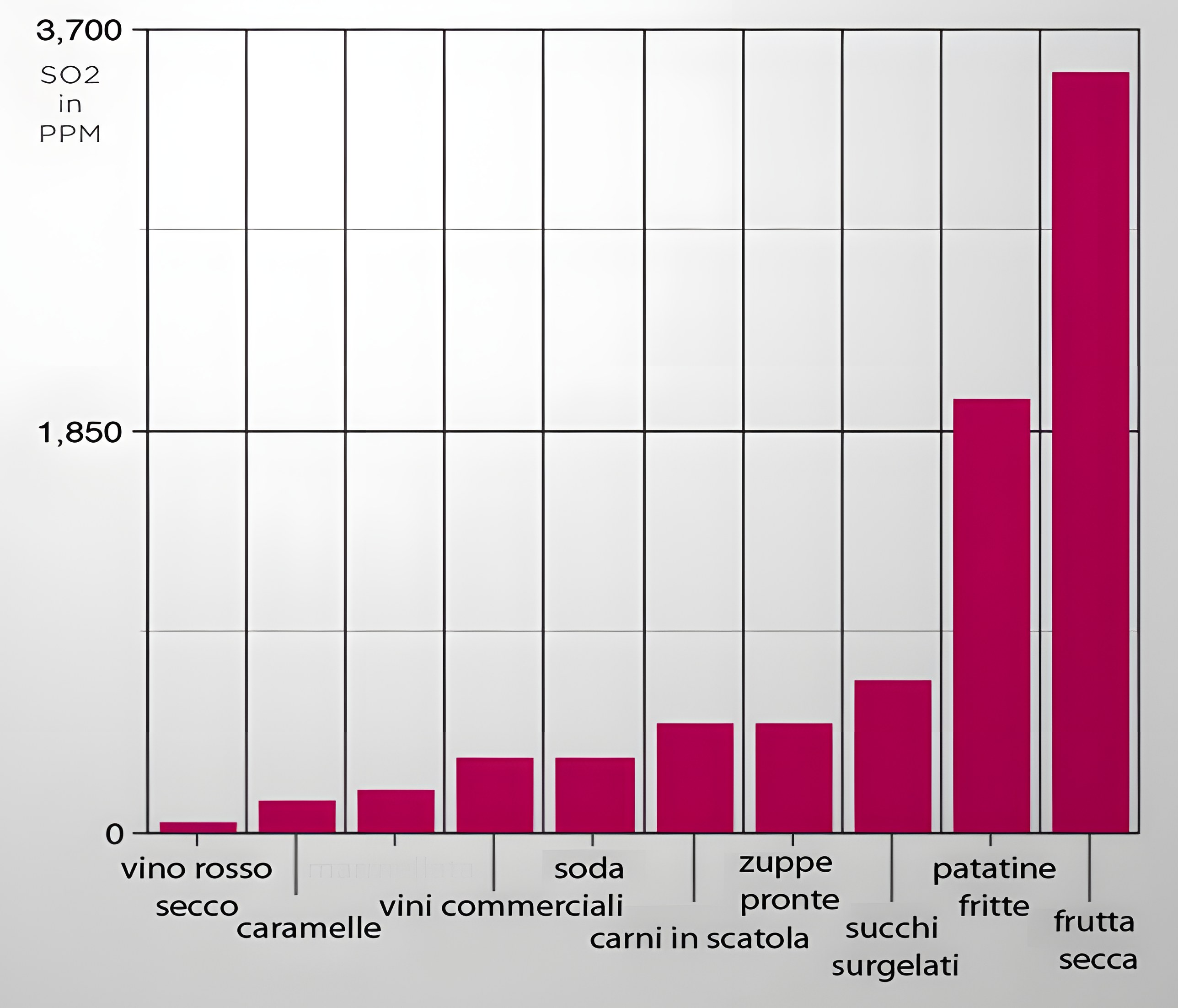
From this it follows that, based on certain studies conducted, the recommended daily threshold is frequently exceeded.
Another effect associated with sulfur dioxide in wine is headaches – has it ever happened to you?
Certainly the first suspect has been wine!
But why, then, does this not happen when we eat dried fruit, which contains far more sulfur dioxide?
In practice, the sensation of a tight band around the head that can occur after ingesting a significant dose of sulfur dioxide appears to be linked to the action of sulfite reductase, an enzymatic hemoprotein that oxidizes sulfites to sulfates, consuming – albeit in limited quantities – oxygen. This would limit the flow of oxygen to the brain, which would react with the well-known painful symptoms; however, this phenomenon is not particularly frequent or pronounced.
This issue is more often linked to acetaldehyde (a substance derived from the first transformation of alcohol by the liver), which enters the bloodstream. Indeed, Disulfiram – the active molecule in products that help people stop drinking – works by retaining and slowing the transformation of this substance in order to fix this uncomfortable state.
One final clarification regarding organic wines: the law provides that even these are not prohibited from using sulfites, but limits are set which vary depending on the residual sugar content. Therefore, their sulfite content may be lower, higher, or average compared to conventional wines.
Completely eliminating sulfur dioxide from wines is not possible, as it is also a by-product of fermentation. What has been attempted is to reduce the use of added sulfites, also through European-funded projects.
It should be noted that wines with less than 10mg/L can be considered sulfite-free wines.
To produce a wine "without (added) sulfur dioxide," the key pillars are:
- Healthy, mold-free grapes
- Use of selected yeasts
- Avoiding contact with oxygen
- Use of inert gases
- Avoiding prolonged aging
Wines without this important additive rarely "age well and for a long time."
By doing good work in the vineyard and in the cellar, it is possible to reduce the use of added sulfites – but we must not improperly demonize an additive that has been used in winemaking since nearly the very beginning, nor assume that sulfite-free wines are better or entirely "pure."
As with all things, the old saying holds: "too much of anything is bad."


What do you think?
Log in to leave a comment