


We have already covered the wines of the Abruzzo winery Marramiero, which I had the fortune of visiting last April. The most recent review dates back to the Brut Rosé metodo classico, tasted at the Roman restaurant Piero & Francesco and paired with a dish of fusilloni con calamari e asparagi. But the wine that introduced me to Marramiero was the Trebbiano Altare 1996, tasted two years ago – a wine whose memory of integrity and beauty has remained intact over time.
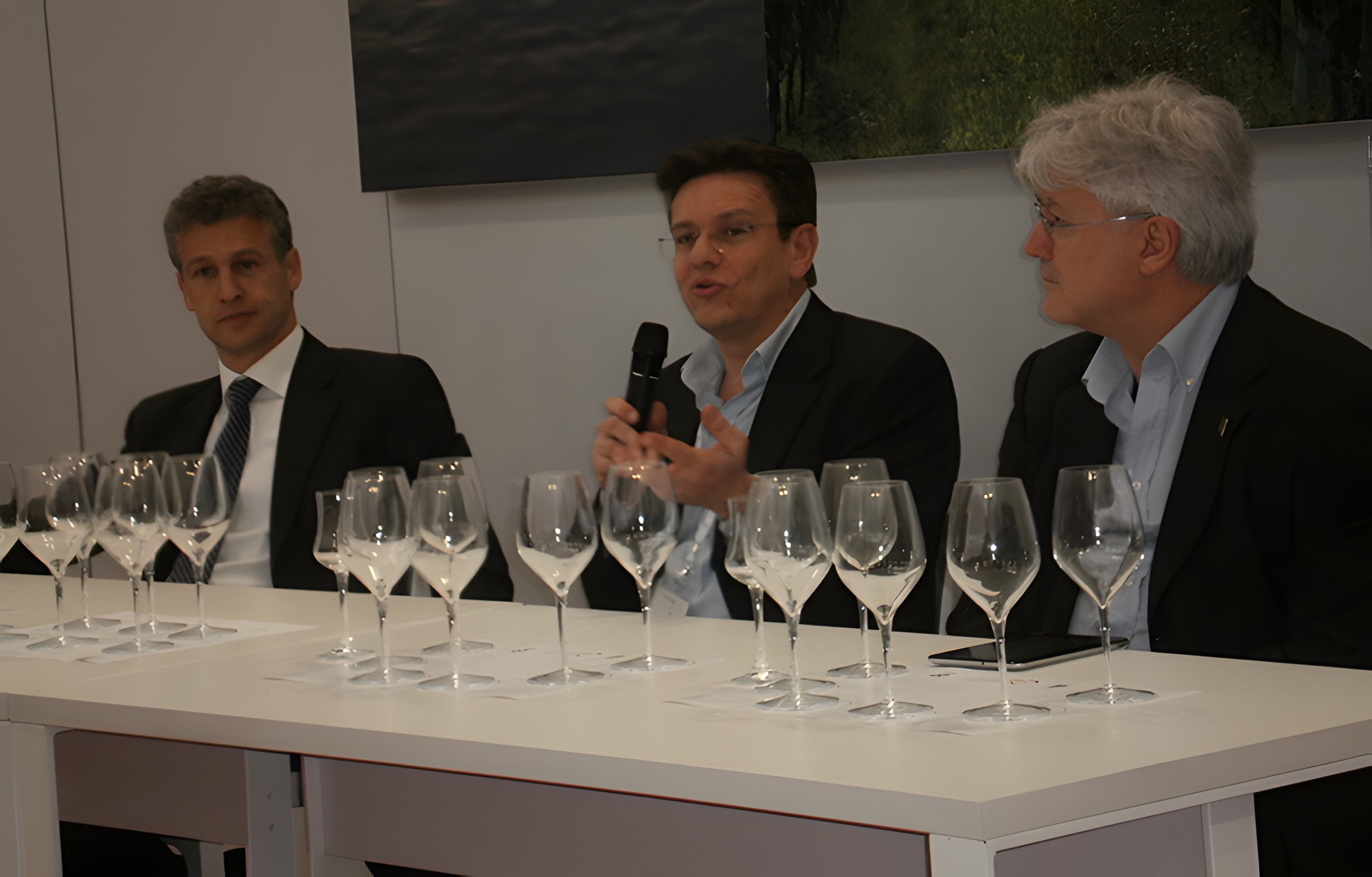
And at Vinitaly I happened to attend a vertical tasting of Trebbiano Altare from the '90s. Four vintages, from 1994 (the very first) to 1997, were presented alongside two steel-only Trebbiano wines from the same period, the Anima 1996 and the Dama 1997. The tasting, led by Francesco d'Agostino – director of Cucina & Vini – together with Enrico Marramiero and winemaker Romeo Taramborrelli, concluded with a house specialty, the vino cotto Livia.
The Trebbiano used to make the Altare comes from vines up to 50 years old, planted at an altitude of over 200 metres above sea level and well sheltered by the Gran Sasso massif. The vineyard faces south-west, with significant temperature variations between night and day, as well as between seasons.
The wine is conceived and designed in the vineyard from the very first cultivation. In this regard, the strong temperature swings combined with the age of the vines, the soil characterised by the presence of clay and tufa, the low environmental impact – thanks to cultivation methods that respect the habitat – and yields below 60 quintals per hectare, are all conditions that support the vegetative process and the accumulation of aromas in the Trebbiano berries. Ultimately, these are the factors responsible for the decisive elevation in the quality of the raw material from which the wine is made. Even the sorting and harvesting of the grapes are carried out by hand, based on the ripeness level of each individual berry.
At the end of harvest, the bunches are transported to the winery in small crates. Here the pressing is gentle and the free-run must is transferred into new barrique, together with the skins and seeds, to undergo cryomaceration at around 3°C. At the end of the process, which involves the use of oak for 18 months, the wine is ready. And as demonstrated by the samples at the vertical tasting, it is ready to be enjoyed even after two decades.
Trebbiano d'Abruzzo Altare 1994
Golden yellow in colour, on the nose we detect hints of sultana raisin, honey, earth and a small wood of liquorice. After a while, notes of apricot jam and dried fruit also emerge on the finish. On the palate we perceive a dynamic freshness that highlights all the wine's vitality. It closes long on notes of exotic fruit.
Trebbiano d'Abruzzo Altare 1995
The amber yellow colour already tells us that this sample has evolved differently. The impression is confirmed on the nose: alongside notes of dried flowers and fruity echoes of dehydrated apricot, we detect clear lacquer-like notes, an evident sign of the wine's age. The flavour profile shows greater fatigue, although the acidity is still clearly perceptible.
Trebbiano d'Abruzzo Altare 1996
We return to golden hues, with a beautiful luminosity. The breadth of the aromatic profile is incredible: hints of toasted almond together with ripe fruit, with apricot jam prominent. Then notes of eucalyptus, aromatic herbs, acacia honey and finally hydrocarbons. On the palate it is still lively, with a glyceric softness that nonetheless well compensates a still very present acidity. Long the balsamic finish. As mentioned, I had tasted the Altare 1996 two years ago, and it is as if those two years had never passed.
Trebbiano d'Abruzzo Altare 1997
A wine still golden yellow in hue. The aromatic profile recalls the 1994 closely. From the glass emerge fruity notes, syruped peach above all, then apricot jam. Then acacia honey, menthol and almond notes on the finish. Beautiful freshness on the palate, with a long finish that remains fruity.
What can we add? It is extraordinary how this wine manages to travel through time, with peaks of excellence found in the 1996 sample, still absolutely intact and of rare complexity. Trebbiano Altare tells us that it was made with great production expertise but also with an absolute respect for the territory. And above all that it is produced using a great Abruzzo grape variety, Trebbiano. Confirmation also comes from the two steel-only wines present at the tasting, the Anima 1996 and the Dama 1997, both still enjoyable – keeping in mind that the Dama is to be considered the entry-level Trebbiano of the estate.
I hope at this point to be able to attend experiences like this again.


What do you think?
Log in to leave a comment